
Manuscript Health
Manuscript Health gives you a birds-eye view of your writing patterns. No AI, no cloud — just pure algorithmic analysis of your prose. Use it to spot habits, not to follow rules.
How to Open
Section titled “How to Open”- Click Manuscript Health on the Project Overview card grid
- Or open it from the sidebar tools menu (gear icon) under Views
Overview Tab
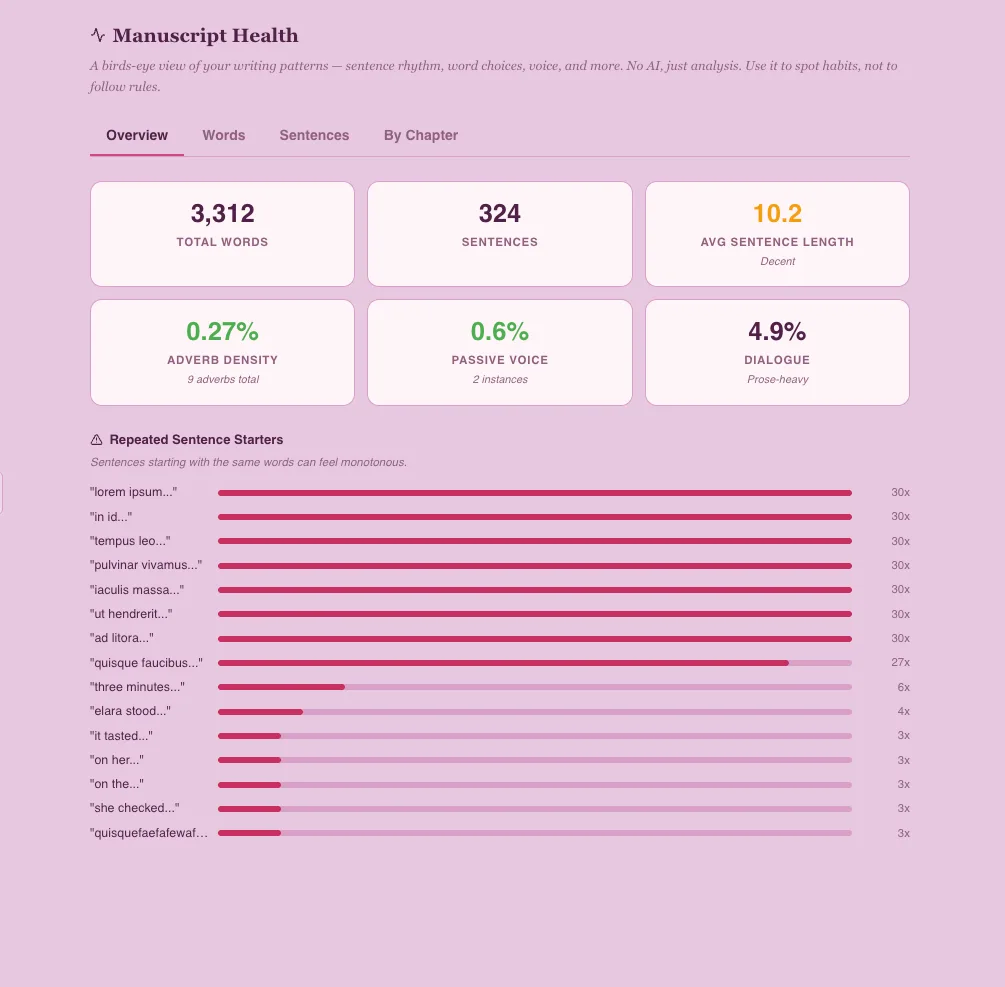
Section titled “Overview Tab”Six stat cards at a glance:
- Total words and sentences across your manuscript
- Avg sentence length — color-coded green (12-20 words), amber (8-28), or red (outside). Good prose varies sentence length; a flat average suggests monotonous rhythm.
- Adverb density — percentage of -ly words. Green under 2.5%, amber under 4%, red above. Adverbs aren’t bad, but overuse often signals weak verbs.
- Passive voice — percentage of passive constructions. Green under 8%, amber under 15%, red above. Passive voice makes prose feel distant when overused.
- Dialogue ratio — percentage of words inside quotation marks. Varies by genre (thrillers run 40%+, literary fiction around 20-30%).
Below the stats, you’ll see Repeated Sentence Starters — sentences beginning with the same two words (“She looked…”, “He was…”) shown as a bar chart. Three or more repetitions get flagged.
Words Tab
Section titled “Words Tab”Top Adverbs
Section titled “Top Adverbs”Your most-used -ly adverbs ranked by frequency. Look for ones where a stronger verb would serve better — “he said quietly” could become “he whispered.”
Most Frequent Words
Section titled “Most Frequent Words”The 30 most common words in your manuscript (excluding stop words like “the”, “and”, “was”). High-frequency words may indicate repetitive phrasing.
Sentences Tab
Section titled “Sentences Tab”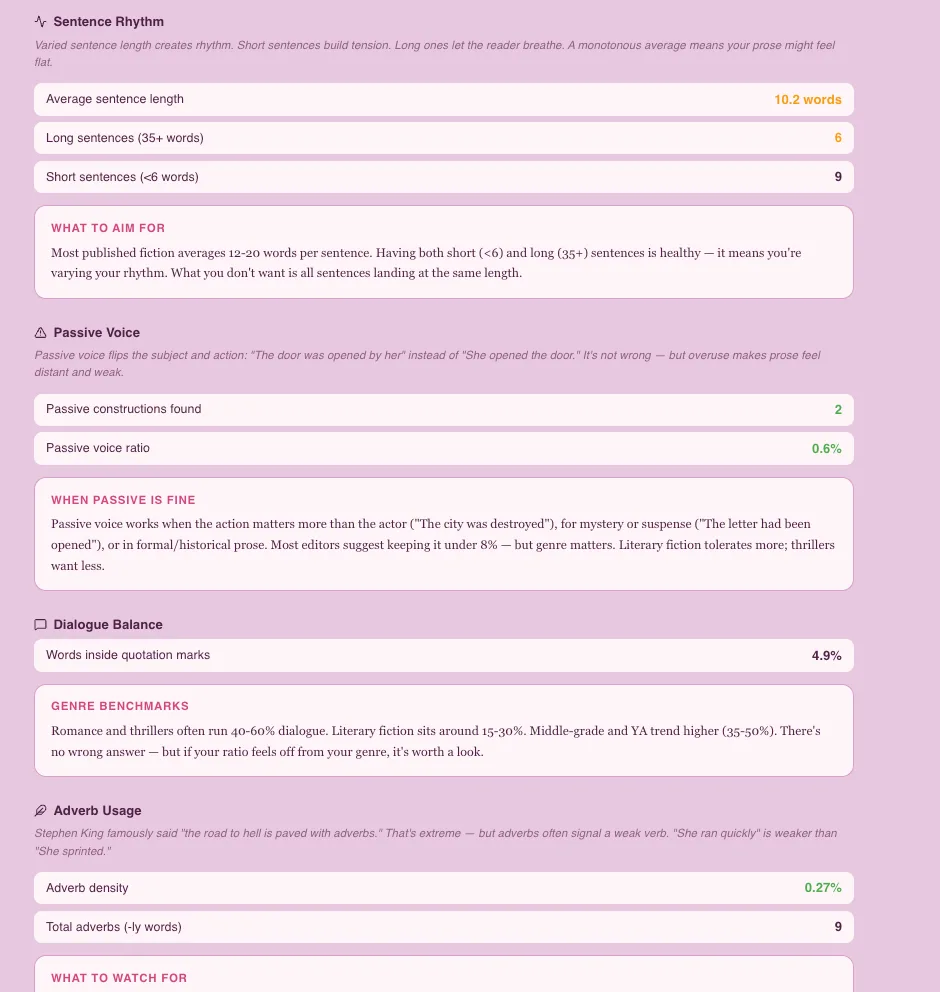
Detailed editorial guidance with explain boxes for each metric:
Sentence Rhythm
Section titled “Sentence Rhythm”Average sentence length, long sentences (35+ words), and short sentences (under 6 words). Varied length creates rhythm — short sentences build tension, long ones let the reader breathe.
Passive Voice
Section titled “Passive Voice”Count and ratio of passive constructions (“the door was opened” vs “she opened the door”). Includes guidance on when passive voice is actually fine — mystery, suspense, formal prose, and historical fiction.
Dialogue Balance
Section titled “Dialogue Balance”What percentage of your words are inside quotation marks, with genre benchmarks.
Adverb Usage
Section titled “Adverb Usage”Density percentage with practical advice. Includes the threshold ranges and tips for which adverbs to cut first (dialogue tags are the easiest wins).
By Chapter Tab
Section titled “By Chapter Tab”A table comparing every chapter side by side:
| Column | What it shows |
|---|---|
| Words | Total word count |
| Sentences | Total sentence count |
| Avg Sentence | Average words per sentence (color-coded) |
| Adverbs | Adverb density percentage (color-coded) |
A color legend at the top explains what green, amber, and red mean. An explain box at the bottom describes each column’s thresholds in plain English.
Color Coding
Section titled “Color Coding”The health indicators use fixed colors that stay distinct across all app themes:
- Green — within the typical range for published fiction
- Amber — slightly outside, worth a glance
- Red — notably outside, worth reviewing (but not necessarily wrong)
These are lenses for spotting patterns, not scores. Every writer’s style is different.